Knowledge Center

Categories

Picture of Vance Zhang

Vance Zhang

M.Sc.,Politecnico di Milano

Industrial Valve Leakage: Internal vs External — Causes, Standards, and Solutions

Introduction Valve leakage is the most frequently encountered failure mode in industrial piping systems. Whether it appears as a slow seep around a valve stem or an invisible flow of gas crossing a supposedly closed seat, leakage costs industry billions of dollars annually in lost product, unplanned downtime, regulatory penalties, and safety incidents. Yet “valve leakage” is not a single problem — it is two fundamentally different problems that require different diagnostic approaches, different repair strategies, and different compliance standards. Internal leakage (seat leakage or pass-by leakage) occurs when a closed valve fails to fully block flow across its seating surface. External leakage occurs when process fluid escapes from the valve body to the surrounding atmosphere. Understanding this distinction is the starting point for any effective valve maintenance and procurement strategy. This guide covers the root causes of both leakage types across common valve designs, the industry standards that define acceptable limits, and the practical measures available to prevent and repair each. Key Distinction:Internal leakage = fluid crosses the valve seat from upstream to downstream while the valve is closed. The leak stays inside the piping system.External leakage = fluid escapes from the valve body into the atmosphere. The leak exits the piping system entirely. 1.

Read More »
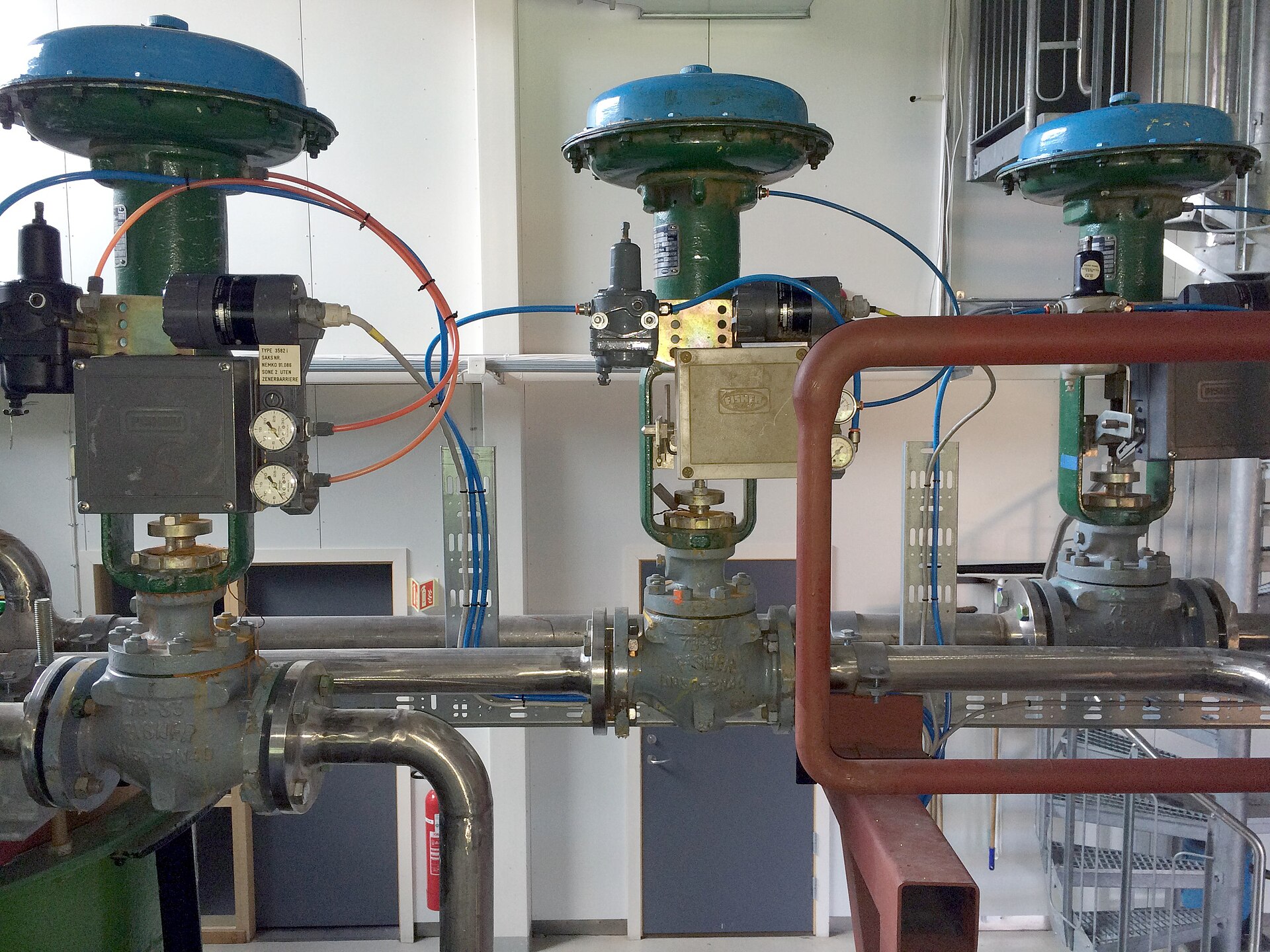
Pneumatic control valves with actuators for pneumatic valve vs electric valve comparison

Pneumatic Valve vs Electric Valve: How to Choose

IntroductionWhen automating industrial valve operations, the choice between a pneumatic actuator and an electric actuator is one of the most consequential decisions in process engineering. Both technologies achieve the same basic objective — opening, closing, or modulating a valve without manual intervention — but they do so through fundamentally different mechanisms, with different strengths, limitations, and cost profiles. This guide breaks down the key differences between pneumatic and electric valves, compares their performance across the most critical selection criteria, and provides practical guidance for engineers and procurement teams. Quick Definition: A pneumatic valve uses compressed air to drive the actuator. An electric valve uses an electric motor (AC or DC) to drive the actuator. The valve body itself — ball, gate, butterfly, globe — is the same; only the actuator differs. Electric ActuatorsElectric actuators use a motor-gearbox assembly to convert electrical energy into torque, which drives the valve stem. They accept control signals ranging from simple on/off (24V DC or 110/220V AC) to analog modulating signals (4–20mA or 0–10V) for precise position control. Modern electric actuators include built-in position feedback, torque limiters, and communication protocols such as HART, Profibus, or Modbus for integration into digital plant systems. Force and Torque


Read More »
CF8M vs SS316 vs SS304 stainless steel ball valve material selection guide for industrial procurement

CF8M vs SS316 vs SS304: Stainless Steel Ball Valve Material Selection Guide

Introduction When specifying stainless steel ball valves, three material designations appear on nearly every datasheet and purchase order: SS304, SS316, and CF8M. For procurement engineers and project buyers, understanding the differences between these materials — and knowing where each belongs in a piping system — is essential for making cost-effective, technically compliant valve selections. This guide explains what each material is, how they compare in performance, where they are used in a valve assembly, and how to choose the right one for your application. Quick Reference: SS304 = CF8 (cast equivalent)  |  SS316 = CF8M (cast equivalent). The “SS” grades are wrought (forged/rolled); the “CF” grades are their cast counterparts used for valve bodies. 1. What Are These Three Materials? SS304 — The Workhorse Stainless Steel SS304 (AISI 304, UNS S30400) is the most widely used stainless steel in the world. It contains approximately 18% chromium and 8% nickel, with no molybdenum. Its cast equivalent is CF8 (ASTM A351). SS304 offers excellent general corrosion resistance, good formability, and is available at the lowest cost among the three grades. It is the go-to choice for non-aggressive environments. SS316 — The Marine-Grade Stainless Steel SS316 (AISI 316, UNS S31600) adds 2–3% molybdenum to the SS304 composition, bringing chromium

Read More »
API 600 vs API 602 vs API 603 gate valve standards comparison guide for industrial procurement

API 600 vs API 602 vs API 603: The Complete Guide to Gate Valve Standards for Industrial Procurement

When sourcing industrial gate valves, three API standards define the global benchmark: API 600, API 602, and API 603. Each serves a distinct purpose — from large-bore high-pressure refinery pipelines to compact small-bore instrument lines and corrosion-resistant stainless steel applications. This guide breaks down the scope, design requirements, and key differences of all three standards, with a practical comparison table and actionable procurement guidance to help engineers and buyers select the right valve for every service condition.

Read More »

Beyond the Visible Leak: What Are Fugitive Emissions and How to Control Them

Fugitive emissions in industrial valves account for approximately 62% of uncontrolled volatile organic compound (VOC) leaks in modern process plants. This technical guide outlines the core mechanics of fugitive leaks, pinpointing critical application areas such as methane handling, hydrogen transport, and thermal cycling. It contrasts prevailing regulatory testing frameworks (API 624/641 and ISO 15848) and delivers actionable engineering control methodologies, including live-loaded packing (LLP) and bellows seals. Finally, it translates these technical parameters into a strategic Total Cost of Ownership (TCO) procurement blueprint, equipping sourcing professionals to mitigate environmental, financial, and HSE liabilities effectively.

Read More »

Seeking Expert Guidance for Demanding Fluid Solutions?

* The data you provide will be used solely for processing your business inquiries and deliver-ing professionaltechnical support. We hereby commit that your information will never besold or disclosed to any third party, andthat it will be strictly protected in accordance withapplicable privacy standards. You may contact us at any time
to update or request the dele-tion of your personal information.

Scroll to Top

Get Your Free Technical Guide & Price List

* The data you provide will be used solely for processing your business inquiries and deliver-ing professionaltechnical support. We hereby commit that your information will never besold or disclosed to any third party, andthat it will be strictly protected in accordance withapplicable privacy standards. You may contact us at any time
to update or request the dele-tion of your personal information.