
Introduction
Selecting the right valve is critical for the long-term integrity of any fluid transport system. The Resilient Seated Gate Valve has become the industry standard for isolation service in water and wastewater applications. However, choosing the correct specification requires a deep understanding of its structural limits and performance standards. This guide serves as a foundational selection manual for engineers and procurement specialists.
1. Structural Selection: Material and Design Standards
When evaluating a gate valve, the internal architecture determines its survival in harsh environments.
1.1 Body Casting and Flow Efficiency
A primary selection criterion is the flow path design.
-
- Material: High-grade Ductile Iron (GGG40/50) or Stainless Steel is recommended to ensure structural stability.
-
- Full-Bore Design: For sizes ranging from DN50 to DN1200, ensure the valve is a “Full-Port” design. According to GB/T 12232 standards, the internal flow path must be unobstructed to keep pressure loss below 0.1 bar. This minimizes energy consumption in pumping stations.
1.2 Wedge Encapsulation (EPDM vs. NBR)
The wedge is the primary sealing component. It must be fully encapsulated to prevent core corrosion.
-
- Elastomer Choice: Select EPDM for potable water and general applications (up to 120°C). Select NBR for oil-bearing media or specific industrial fluids.
-
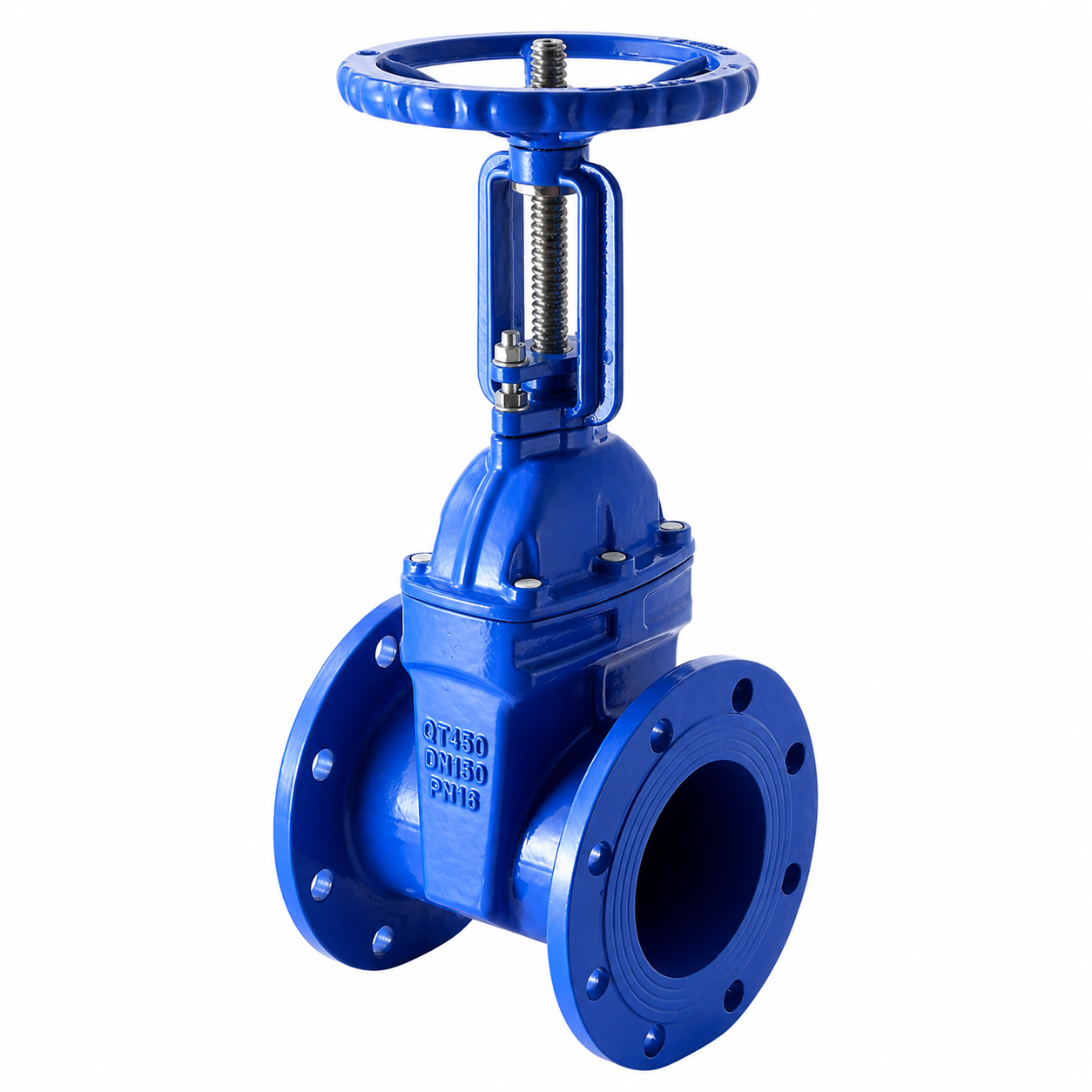
- Sealing Pressure: Standard selection should support PN16 (1.6 MPa). The seal is achieved via pre-compression deformation, ensuring a bubble-tight shut-off.
1.3 Stem and Transmission Specifications
The transmission mechanism influences operational torque and longevity.
-
- Thread Design: Look for a Trapezoidal Thread with a pitch of 4-8mm.
-
- Rising Stem (OS&Y): For critical infrastructure, rising stems are preferred as the 1:1 synchronization between stem lift and gate opening allows for immediate visual status checks.
2. Performance Metrics and Compliance
A professional selection must be backed by verified data and international standards.
2.1 Zero-Leakage Standards
The core purpose of a resilient seated valve is Isolation Service.
-
- ISO 5208 Class A: Ensure the valve meets this standard. Selection should be based on test data showing a leakage rate of < 0.01 mL/min.
-
- Operating Mechanism: For a DN100 valve, the gate should lift approximately 6mm per full rotation of the stem. At full-open, the flow resistance coefficient should be as low as 0.05.
2.2 Pressure and Chemical Resilience
-
- Bi-directional Sealing: Based on API 600 verification data, the valve must handle pressure from both sides (Forward: 2.5 MPa; Reverse: 1.6 MPa).
-
- Surface Protection: The stem should feature Hard Chrome Plating (thickness ≥ 25μm) to prevent friction-induced wear. The internal elastomers must be resistant to chemical variations with a pH range of 2 to 12.
3. CRITICAL WARNING: The “Throttling” Myth
One of the most common mistakes in valve selection is using a gate valve for flow regulation.
Important Note for Selection: Resilient Seated Gate Valves are strictly for ISOLATION (On/Off) service. They are NOT designed for throttling or regulating flow.
Why? When a gate valve is partially open, the high-velocity fluid creates a “wire-drawing” effect. In a resilient seated valve, this will rapidly erode the EPDM/NBR coating, leading to permanent seal failure. Furthermore, high-velocity turbulence can cause gate vibration and mechanical fatigue. If flow regulation is required, a Globe Valve or a V-port Ball Valve should be selected instead.
4. Application-Specific Selection
Depending on the industry, different certifications and features are required:
-
- Municipal Water Supply (45% of Market): Focus on EPDM coating and non-toxic certification.
-
- Industrial Wastewater: Select valves capable of handling solid particles up to 5mm. Ensure the “Flat Bottom” seat design is used to prevent dredging and sediment buildup.
-
- Fire Protection: Ensure UL/FM Certification is present, as these valves are critical for emergency response reliability.
-
- Corrosive Environments: Specify stainless steel internal components and acid-resistant elastomers.
5. Maintenance and Operational Longevity
To ensure a service life exceeding 100,000 cycles, follow these selection and maintenance tips:
-
- Online Maintenance: Select designs where O-rings and stem seals can be replaced without removing the valve from the line (Online replacement). This can reduce downtime by 70%.
-
- The Anti-Binding Rule: During operation, once the valve is fully open, turn the handwheel back 1/2 to 1 full turn. This prevents the stem from locking due to thermal expansion.
Conclusion
Technical selection for a Resilient Seated Gate Valve should not be based on price alone. By adhering to ISO 5208 leakage standards, API 600 pressure ratings, and strictly avoiding throttling applications, engineers can ensure a high-performance, low-maintenance piping system.
Welcome to WordPress. This is your first post. Edit or delete it, then start writing!